Brew your best beer EVER. Start your Free Trial of Brewer's Friend today! Sign Up ×

Beer, Tap Into the Art and Science – By Charles Bamforth

Sunday, August 31st, 2008

Beer, Tap Into the Art and Science – By Charles Bamforth

If you want to know everything about the history of beer, the processes of brewing, and the chemistry behind each of the ingredients this is the book. It is full of interesting facts and quotes about beer, yet it is a very serious approach. Contains details on the chemical composition of grains and the malting process. The chapter on hops covers the treasured plant’s original shaky introduction into beer in Europe, where and how it is grown, and all facets of its chemical makeup. The chapter on the brewing process is full of details about modern day brew house vessels, quality control, and considerations and trade offs during production.

This book does not touch on home brewing, nor is it a ‘how to’ guide in any sense. It gives an elevated sense of appreciation for beer, its rich history, and elaborate modern production process. The author hammers home the point of nearly freezing beer for at least three days before bottling to drop out the remaining sediment. That may be something to try in my next home brew batch.

Topics unique to this book:

  • History of beer and its ingredients
  • Tables on beer production and consumption
  • Information on the positive health effects of moderate alcohol consumption
  • Large scale brewing process schematic (page 54, 2nd edition)
  • Diagrams of large scale brewing equipment: Mash converter, lauter tun, wort kettle, hot wort receiver, and wort cooler. (starting page 132, 2nd edition)
  • Information on the various defects that can occur in beer and how to correct

Cost Breakdown of Beer, Home Brewing vs. Commercial

Sunday, August 31st, 2008

The relative cost of commercial beer to the consumer is 70% marketing, packaging, and taxes! It is all because of the hefty price of marketing and packaging that home brewers have a substantial economic edge over large scale breweries. Comparing the breakdown to what home brewers pay for the relative ingredients tells us home brewers are paying a lot more for hops and malt. That makes sense due to the buying power large breweries have. Even so, home brewers easily beat the price of store bought beer. Quality is also easy to surpass after the fist few batches.

Large Scale Breweries:

Factor in Price Percentage Weight
Packaging 28.00%
Tax 25.00%
Sales and Marketing 17.00%
Production 15.00%
Malt 8.00%
Minor Ingredients 4.00%
Adjuncts 2.00%
Hops 1.00%
Total: 100.00%

Commerical Brewing Price Breakdown

Data Source: Beer: Tap Into the Art and Science of Brewing, by Charles Bamforth, 2nd Edition, Page 191

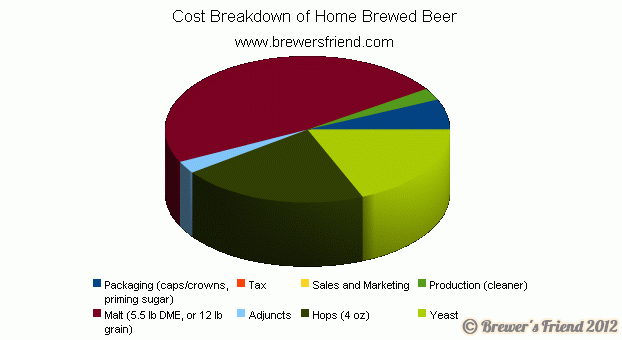
Home Brewing Relative Costs:

This is a basic 5 gallon batch of beer, OG of 1.05. Let’s assume we need 5.5 lb of DME (or 10-12 lb of grain) 4 oz of loose hops, gypsum/irish moss, fresh liquid yeast, 50 bottle caps and some cleaning solution.

Factor in Price Percentage Weight
Malt (5.5 lb DME, or 12 lb grain) 48.00% $18.00
Hops (4 oz) 21.33% $8.00
Yeast 18.67% $7.00
Packaging (caps/crowns, priming sugar) 6.67% $2.50
Adjuncts (Gypsum, irish moss) 2.67% $1.00
Production (cleaner) 2.67% $1.00
Tax 0.00% NA
Sales and Marketing 0.00% NA
Total: 100.00% $37.50

Commerical Brewing Price Breakdown

Closing Thoughts:

The time factor of home brewing is not considered, since home brewing is a hobby and something to be enjoyed. In other words, this hobby pays for itself. Check out the break even cost article for more details on that:
https://www.brewersfriend.com/2008/06/07/break-even-cost-of-home-brewing/

Standards of Brewing – By Charles W. Bamforth, Ph.D, D.Sc.

Saturday, August 30th, 2008

Standards of Brewing – By Charles W. Bamforth, Ph.D, D.Sc.
A Practical Approach to Consistency and Excellence

For a home brewer who likes numbers and math, it is a fairly interesting peek into what brewing for a living looks like. Lots of details about how to test ingredients for quality. Making consistent beer every time on a large scale is a tough job!

The target audience of this book is brewing staff employed by large beer breweries. Covers procedures on quality assurance relating to the entire brewing process. The idea of scientifically testing beer at each stage is intriguing but not very practical for the home brewer. Large scale brewing is extremely technical, involving lots of scientific testing and data analysis. At each step in the beer production process quality control plays a huge role. There are many ‘tweaks’ that can be done along the way to a adjust a beer’s final profile. Some of these are way out there for a home brewer, and it makes me trust my home brew a lot more over commercial beer because I know exactly what is in it!

Topics unique to this book:

  • Large scale brewing practices
  • Using statistical measures to control brewing quality
  • Twenty key quality control checks in a brewery
  • Breakdown of statistics on ingredients (grain, water, hops, yeast)
  • Water quality standards tables by impurity
  • Chemistry involved in brewing

The Complete Handbook of Beers and Brewing – By Brian Glover

Saturday, August 16th, 2008

The Complete Handbook of Beers and Brewing – By Brian Glover
The beer lover’s guide to the world

This book is not about home brewing, it is about beer. Every page contains vivid color images of beer labels, bottles, ingredients, production, and people enjoying beer. The first section briefly covers the history of beer, its ingredients, production, and styles. The second, and much more lengthy section is an encyclopedia of beers from around the world organized by country and brewery with many pictures of the different labels and bottles.

If you are planning a trip to Europe to sample beers, avoid Norway, Sweden, and Finland because of their high tax rates on beer and historical restrictions on alcohol. “Norway levies the highest and most punitive rate of duty on beer in the world”, page 116

The best place to go is Belgium and Germany:
“About 30% of all the breweries in the world are in Germany.” page 146

Awesome quote:
“Make sure that the beer – four pints a week – goes to the troops under fire before any of the parties in the rear get at drop.” – Winston Churchill, in a note to the Secretary of State, 1944.

Topics Unique to this book:

  • History of beer and brewing

  • History of prohibition and brew during war times

  • Overview of large scale production of beer

  • Description of 75 different classifications of beer

  • Tour of beers from 32 regions

Barley Wine, 2008 Recipe

Sunday, August 10th, 2008

I will brew Barley Wine every spring so it is ready by winter. Next time I will try using champagne yeast a few days into the primary fermentation to get the final gravity down. Extra hops would help give it a more awesome bitter flavor. A full wort boil would also get the utilization of the hops higher. I created the IBU calculator on this site after I brewed this batch, had I checked it I would have known to add more hops. This is an expensive batch of beer and it takes a long time to ferment and age in the bottle, but it is worth waiting for. It is not a beer you can drink a lot of in one setting. It is more of a beer you drink from a snifter to finish off the night.

Target Volume (Gallons) 6      
Total Cost $62.55
 
   
Yield (ounces) 712      
Cost per 12 oz bottle $1.05      
Boil Time 90 min    
         
GRAINS  Pounds  Points/Gal  Total Points  Cost 
Light LME 16.7 37 617.9 $32.57
Honey, stonewood hallelujah 0.05 35 1.75 $0.00
Dark DME 1 45 45 $3.85
Steep – 40 min at 150 F         
Crystal 20 1 28 28 $1.00
Crystal 80 1 28 28 $1.00
Chocolate 0.25 28 7 $0.25
Special B 0.25 28 7 $0.45
         
HOPS  Ounces  Alpha Acids Boil Time (min)  Cost 
Domestic Magnum 2 14.90% 90 $4.00
Amarillo 1 9.60% 60 $4.00
Amarillo 1 9.60% 10  
Centennial 2 9.30% 10 $4.50
Yamhill Goldings 1   dry hop secondary $2.00


YEAST  White Labs California Ale     Cost 
Attenuation Low 73%     $6.58
Attenuation High 80%      
Optimum Temp 68-73 F      
Flocculation Medium      
Starter No      
         
STATS         
Expected Original Gravity 1.122       
Expected Final Gravity 1.024 – 1.03      
IBUs 52.31      
Apparent Attenuation 68.18% AA = 1 – FG / OG    
Alcohol By Volume – Theoretical 11.48%      
Alcohol By Volume – Potential 9.84%      
         
BREWING:  Squeezed out hops bags thoroughly      
  ½ tbs Irish Moss at start of boil     $0.10
         
Water Source Wort Pure water filter – 3 gallon boil      
Water Source Dilution Pure water filter      
         
DATES  Date SG Cum. Days Notes
Brewed 05/08/08 1.110 0   
Racked 05/19/08 1.050 11 Smelled honey in the yeast, yummy
Dry Hopped 05/26/08 1.038 18 1 oz Yamhill Goldings, loose
SG Sample 05/28/08 1.038 20 Lots of yeast particles floating still
Racked II 06/01/08 1.036 24 Tastes great! still a bit syrupy, excellent complex bitter finish
Bottled (SG pre bottling) 06/07/08 1.035  30  


OK TO DRINK BY (180 days): 11/04/08       
         
         
BOTTLING         
Priming Method 6.5 oz Corn Syrup     $0.50
Caps, cleaners, etc
 
    $1.75


Container  Capacity  Qty  Total Volume   
Bottle 12 54 648  
Jug 64 1 64  
    Total Bottled:  712   


TASTING  Date Days    
  06/22/08 45 No carbonation or head, excellent malty flavor, not as bitter as I would like, the goldings really comes out and the spices from the Amarillo hops are nice.
  08/15/08 99 Not as bitter as before, chocolaty and a little sweet rich malty flavor.  
      Creamy in the mouth, with a complex hop finish.  


Brewing the World’s Great Beers – By Dave Miller

Sunday, August 3rd, 2008

Brewing the World’s Great Beers – By Dave Miller
A step-by-step guide

This was the most balanced book I could find on how to brew beer at home. Some books go into too much detail about all sorts of things such as PH, water balance, and yeast cell counts. This book mentions those concepts briefly but stays focused on helping you learn to brew step by step. Other books omit too many details, or glaze over certain key concepts and left me a little confused. It is easy to read and contains plenty of drawings. The tables are also useful to refer back to.

This book has great information on advanced concepts. For those of you looking into going ‘all-grain’, this book contains a full explanation of the additional equipment you will need and the procedure. Interested in kegging, force carbonation, filtering? This book has that too.

Topics Unique to this book:

  • One of the best explanations on brewing for beginners.
  • Brewing with malt extract plus steeping grains.
  • How to start all grain brewing: mashing, lautering, and sparging.
  • Using draft systems, kegs, CO2 for bottling, large batch brewing.

Brewing Classic Styles by Jamil Zainasheff and John J. Palmer

Saturday, August 2nd, 2008

Brewing Classic Styles by Jamil Zainasheff and John J. Palmer
80 Winning Recipes Anyone Can Brew

Browsing through the 80 recipes in this book was a great source of inspiration for my next batch of home brew. If you can’t decide what to do next, pick up this book. There is bound to be something you haven’t tried.

The title is misleading, the sub-title would be more accurate. It is primarily recipes. The book contains short introductory chapters on ingredients and brewing that other books have covered in more detail. If you don’t know what terms like lovibond, OG, FG, and IBU are I would read an introductory how to brew book first.

The recipes are primarily setup for all grain brewers. For extract based brewers the recipes are modified to ‘fit’ the style. I get the sense the authors are all grain brewers who wanted to broaden the market for their book by adding the extract formulations.

This is a great book to browse and see what a style has in common in terms of grains, hops and yeast.

Topics unique to this book:

  • Recipe categories include: Light Lager, Pilsner, European Amber Lager, Dark Lager, Bock, Light Hybrid, Amber Hybrid , English Pale Ale, Scottish and Irish Ale, American Ale, English Brown Ale, Porter, Stout, Indian Pale Ale, German What and Rye , Belgian and French Ale, Sour Ale, Belgian Strong Ale, Strong Ale, Fruit, Spice Herb or Vegetable, Smoke and Wood Aged, Specialty Beers.
  • A nice chart of hops and the various characteristics of each is on page 20.

Per Batch Miscellaneous Item Costs

Sunday, July 27th, 2008

When calculating the cost of a batch of beer, it is easy to overlook the little items like sanitizer, bottle caps, clarifier, priming sugar, and specialty items like burton/gypsum salts or Irish moss. For those of us who keg our beer, don’t forget we have to pay for CO2 recharges every couple of years. For the time being most places in North America can take clean fresh water for granted, though some people do prefer to brew with spring water. No matter what, home brewing is STILL cheaper than store bought beer, because there is no marketing, packaging, labor, or transportation costs to deal with. Even if home brew was more expensive, it still tastes better and is more satisfying to drink.

Item Desc Cost/Batch
StarSan Santizier Use approximately 1 ounce (30 ml) per batch $0.95
Bottle Caps Estimate 50 (max) at $0.02/cap $1.00
Misc Ingredients
Burton Salts For English Ales, 1 ounce $0.20
Irish Moss Use ½ tsp per batch $0.20
Gelatin Use 1 tsp per batch $0.25
Priming Sugar – Corn Syrup 6 oz per 5 gallons $0.40
Priming Sugar – Light DME 8 oz per 5 gallons $1.75
Kegging
CO2 If you are kegging a 5 gallon batch $1.00
Line Cleaner $0.25
Kegging
Water? If store bought spring water used in beer (5 gal) $5.00
Carbon Filter wear and tear on filter $1.00

Healthy Fermentation Video

Sunday, July 27th, 2008

This video shows you what healthy ale fermentation looks like. It is an IPA, with OG 1.06, after three days in the primary fermenter.

Extreme Brewing – By Sam Calagione

Saturday, July 26th, 2008

Extreme Brewing – By Sam Calagione
An Enthusiast’s Guide to Brewing Craft Beer at Home

This book contains 25 fun and ‘extreme’ beer recipes. The introduction surrounding the makeup of ingredients is well done and more detailed than most books. This book contains a lot of photography and the images are excellent. The intro to brewing chapter is a good review, but there are other books out there that go into more detail. Get this book for the information about using fruits and spices in your beer, or the best beer and food pairings. The recipes are extract based, which makes them accessible to beginners, but some of the recipes are also quite complex.

Topics unique to this book

  • Brewing with fruit: (apricots, arctic cloud berries, black currants, blueberries, white muscat grape concentrate, raisins, raspberries, sour cherries, strawberries, sweet cherries)
  • Brewing with spices: (allspice, anise, cardamom seed, chicory, coriander, cinnamon sticks, coffee, ginger, grains of paradise, juniper berries, licorice root, rosemary, saffron threads, spruce tips, st. john’s wort, valerian).
  • Brewing with other ingredients: (pumpkin, pepper corns, molasses, wood chips, etc)
  • Adding sugar during fermentation to boost ABV
  • High gravity beers

I love the passion of this author and the Dogfish Head Craft Brewery, and highly recommend both of his books.