Mash Guidelines
|
Amount
|
Description
|
Type
|
Start Temp
|
Target Temp
|
Time
|
|
6.8 gal |
Mash-In |
Infusion |
153 °F |
153 °F |
75 min |
|
|
Mash Out |
Vorlauf |
153 °F |
168 °F |
10 min |
|
0.25 gal |
Top-off Water |
Sparge |
168 °F |
168 °F |
5 min |
Starting Mash Thickness:
2.4 qt/lb
Starting Grain Temp:
75 °F |
Priming
|
Method: co2
Amount: 12.49 psi
Temp: 40 °F
CO2 Level: 2.52 Volumes |
Target Water Profile
Hoppy Red Ale
Notes
An American Amber Ale that borders on the edge of a Red IPA.
Adapted from the recipe "Left on Red" by The Apartment Brewer.
YEAST
Yeast is Lalbrew Nottingham High Performance Yeast (two 11g packets) - an experiment with an English style yeast that has some ester forming tendencies.
A proper hydration needs to be done, maybe an hour or more before pitching.
MASHING
Mash in at 153° F. Stir rapidly. After all is combined very well, allow to rest about 10 min, then measure pH. If it is higher than 5.45, add acid to adjust, but it is unlikely the mash will be higher than this amount.
REGULAR MASH
Mash for 75 minutes at 153° F, checking pH and gravity to determine if it is necessary to mash longer than 75 minutes. Pre-Boil Gravity should be at or near 1.048. Check pH, and adjust. If gravity is not at or near 1.048, mash longer.
MASH OUT
Increase power to 85% and ramp-up to 168° F for the mash-out/vorlauf. Mash-out is of 15 minute duration.
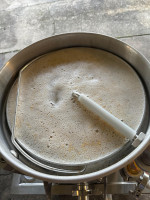
RAISING THE GRAIN BASKET
Turn off recirculation. Raise the grain basket and hang on side of kettle as usual.
Turn off valves, making sure the 3-way whirlpool valve is open only on the RIGHT side, not the mash recirculating side. Remove small hose from recirculation flow meter, and allow to empty into a vessel, then put liquid back in kettle. Connect long recirculation hose to left side of 3-way valve.
RECIRCULATION OVER GRAINS
Secure recirculation hose over grain basket using a clamp. Now, open 3-way valve to center position. Start recirculation, regulating flow rate through pump exit valve. Allow to recirculate over grains for 15 minutes at a moderate flow rate.
DRAINING GRAIN BASKET
Adjust 3-way valve so recirculation valve (left side) is closed. Remove long recirculation hose and allow to drain into vessel, then return liquid to kettle.
Allow grain basket to drain for 15 minutes. Add sufficient sparge water by pouring slowly over the grains, until the pre-boil volume in the kettle is 6.74 gallons
Remove basket and hang over bucket to catch remaining fluid draining. In the meantime, allow whirlpool recirculation to proceed as liquid ramps up to a boil. When draining is complete, add remaining liquid to kettle.
RAMPING UP TO A BOIL
Turn off pump, shut off all valves, then MAKE SURE BREW COMMANDER IS SET IN BOIL MODE. Set power at 85-95%. Drain all hoses into bucket, then collect sample for measuring OG, pH, etc. Put remaining liquid in kettle. Continue with ramp up to boil.
While the boil is ramping up, and during the boil, set up the Blichmann Therminator chiller, and the oxygen stone setup. Make sure the Fermonster fermentor is clean, sanitized and ready. Have transfer hose soaking in solution of Star Sans.
WHIRLPOOL
Turn off heat, allow wort to settle for a few minutes. Now, open valves to allow recirculation of hot wort from the kettle to recirculate through the Therminator to sanitize it. After 10 min, start flowing tap water through the chiller's cooling system, and allow temp to drop to 175° F, and immediately turn off the flow of tap water. Allow temp to stabilize at 165℉ , then add the whirlpool hops (in mesh bag) and allow recirculation to continue for 15 min.
TRANSFER TO FERMONSTER
After this is complete, turn tap water recirculation back on, and allow temperature to drop as low as it will go. Then, use ice water recirculation through the chiller to chill down to about 60° F. At this point, use the 3-way valve on the chiller to divert flow from recirculating to flowing out through the O2 setup and the transfer hose into the Fermonster. Put the screw-on cover onto the fermentor.
SETUP FOR FERMENTATION
Move, with assistance, the full Fermonster containing the finished wort to the chest freezer/inkbird setup. Temperature should be set for 65° F. Tape the inkbird temperature probe to the side of the vessel. Close the cover of the chest freezer and allow temperature to drop to 65℉. Put the Tilt Hydrometer in place, then add the re-hydrated 2 packs of yeast and the Zinc Buddy solution, then put the cap back on. Swirl fermentor to make sure all yeast is completely dispersed.
Replace the cap with the temperature probe/airlock bubbler. Allow to ferment until gravity reaches terminal gravity, and remains stable for at least 48 hrs.
DRY HOPPING
Add the dry hops after the terminal gravity stabilizes. Add the Brewzyme D now (?). Allow to remain 4 days. Now, it's time to crash cool.
CRASH COOLING
Slowly, over a day, crash cool the fermented beer to around 34° F.
TRANFER TO KEG
Set up the "floating dip tube" to the Fermonster. Using techniques to limit any O2 absorption, transfer the finished beer to the keg.
FORCED CARBONATION
Add 30 psi of CO2 to keg, and check this daily for 2 days. Test beer for carbonation. Continue carbonating, or if it is sufficient, keep keg at around 5 psi pressure.
Last Updated and Sharing

- Public: Yup, Shared
- Last Updated: 2026-09-17 02:39 UTC
For quick copying and pasting to a text based forum or email.
Click the Download as HTML file button below.
Recipe costs can be adjusted by changing the batch size. They won't be saved but will give you an idea of costs if your final yield was different.
|
Cost $ |
Cost % |
| Fermentables |
$ |
|
Steeping Grains
(Extract Only) |
$ |
|
| Hops |
$ |
|
| Yeast |
$ |
|
| Other |
$ |
|
| Cost Per Barrel |
$ 0.00 |
|
| Cost Per Pint |
$ 0.00 |
|
| Total Cost |
$ 0.00 |
|
Discussion about this recipe:





 Recipe Tools ▼
 Brew!
Brew!