
- Joined
- Mar 14, 2018
- Messages
- 11,208
- Reaction score
- 21,011
- Points
- 113
That'll do it!Nope, I never bought one for it, lol. I just stick my finger over the end and draw out a sample

That'll do it!Nope, I never bought one for it, lol. I just stick my finger over the end and draw out a sample

Humorous, but sadly true in some US states.I think plastic straws are outlawed in Canada.
Plastic shopping bags too.
Don't worry though, we have a multitude of single use plastics that we can still inflict upon this planet!
I just happen to still have a pack of them and I figure I may as well use them.I think plastic straws are outlawed in Canada.
Plastic shopping bags too.
Don't worry though, we have a multitude of single use plastics that we can still inflict upon this planet!

I do like that most of the paper straws, that don't work worth a crap, are packaged in plastic. lolI think plastic straws are outlawed in Canada.
Plastic shopping bags too.
Don't worry though, we have a multitude of single use plastics that we can still inflict upon this planet!
Oh the irony!I do like that most of the paper straws, that don't work worth a crap, are packaged in plastic. lol
like Celine Dion? ;-)I think plastic straws are outlawed in Canada.
Plastic shopping bags too.
Don't worry though, we have a multitude of single use plastics that we can still inflict upon this planet!
Most, but not all have ATC (Automatic Temperature Correction) however, if you read their instructions, that usually takes 20–30 seconds to fully settle down depending on how hot the wort is. Same goes for pH meters. Always calibrate your instruments before brewing using distilled/RO water. For a refractometer, that involves adding a few drops and while reading it, adjusting the fine tuning calibration screw near the eyepiece to read precisely zero Brix. (and adjust your focus)I have a refractometer, though I'm not 100% convinced of it's accuracy. Can a refractometer handle the 2 drops of boiling wort, and does it need to be corrected, or should those drops be cooled before application?
Todd

Most, but not all have ATC (Automatic Temperature Correction) however, if you read their instructions, that usually takes 20–30 seconds to fully settle down depending on how hot the wort is. Same goes for pH meters. Always calibrate your instruments before brewing using distilled/RO water. For a refractometer, that involves adding a few drops and while reading it, adjusting the fine tuning calibration screw near the eyepiece to read precisely zero Brix. (and adjust your focus)
Finally, be sure you are using one that measures Brix and not Specific Gravity. The function of a refractometer is more closely aligned with sugar content than the gravity of the liquid. (that is what a hydrometer is for) While some have both scales (or sadly only SG) the translation is not exact or linear. Safer to use Brix and enter that in BF.
Finally, check out the instructions for determining your Wort Correction Factor for the refractometer. What you are doing there is calibrating it to your hydrometer for consistent readings. I know 30 readings looks daunting, but you can fudge that a bit and knock it out in 2 or so brews. Just take 5 refractometer readings for Mash Complete, Pre-Boil & Boil Complete/BrewDay Complete and compare them all to the same hydrometer reading. That will get you 15 readings per brew. For even better accuracy, average the five readings in future brews once you've established the correction factor. I like to take one at each compass point on the kettle, and one in the center - after stirring.
High, as in the hydrometer reading, had I taken one, would be less than 1.018, as in 1.017 or lower? Just to clarify, as I am hoping it is a much lower number this close to bottling day.Agree: a refractometer will always read high in the presence of alcohol. 1.018 is not accurate.
Nice photos though!

A refractometer is for liquids WITHOUT alcohol (for OG).
At 10 days, you should be finished. Check with a hydrometer to find out what it actually is. The refractometer will probably be okay to tell you whether it's changed over a day or two. When you get the same reading for 2 or 3 days (ideally with a hydrometer for accuracy), the beer is done. Sometimes you'll get a stall but most likely at 10 days, your beer is somewhere between .010 and .012 which would be fine.High, as in the hydrometer reading, had I taken one, would be less than 1.018, as in 1.017 or lower? Just to clarify, as I am hoping it is a much lower number this close to bottling day.
TG
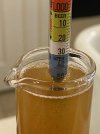
BF has a Refractomer Calculator *with* alcohol to be used after pitching yeast. (so for fermentation samples and packaging) You'll need the OG for it to correct properly. You may also need to 'flatten' the beer by letting it sit out a bit, or pour it back and forth to release any suspended CO2, though unless you are fermenting under pressure, that probably isn't critical.I took a gravity reading last night only using the refractometer. I first calibrated with distilled water, then wiped dry. I then took a pipette to gather and dispense a couple drops of beer onto the glass. The resulting readings are in the pictures below. I did not take a hydrometer reading last evening, nor did I take a refractometer reading prior to yeast pitch. I will, however, be utilizing both instruments from now on. The beer is at 10 days fermentation and reading 1.018 on the refractometer as of last night. The OG prior to yeast pitch, according to my hydrometer (shown previously) was 1.046 prior to yeast pitch.
Does the 1.018 reading last night seem off for any reason? The recipe final gravity has me shooting for 1.009, which I may reach at the 2 week mark.
Thoughts anyone?
Thanks,
Todd
View attachment 33329
View attachment 33330