
Joys / challenges of winter beer brewing in the Midwest

JWR_12

Member
Premium Member
Established Member
Joined
Oct 28, 2023
Messages
48
Reaction score
46
Points
18
Hi everyone,

Thank you for your advice on various matters. Here's another one. After the big winter storm, it's been frozen here in Illinois, and it looks like things will stay beneath freezing for the foreseeable future. This raises some challenges / opportunities.

Challenge: so I use a coil chiller I hook up to my backyard hose to cool the wort. However, at the moment the hose is frozen solid, so that's a no go. Obviously, since it's so cold out, I could just leave my fermenter outside for a bit to cool things down. But I'm wondering if that's going to work fast enough. I know that in partial-mash recipes where I'm diluting the wort with cold water after boil (Palmer method), people just leave things to cool over night. But that's already having knocked a lot of temperature down with the cold water. I'm wondering if just leaving a post boil batch (covered in a fermenter) for a few hours to chill down is okay.

Opportunity: So my home office garage will be a stable 44 degrees or so for a month or so. Is this cold enough to lager in?

Thanks!

 
Hi everyone,

Thank you for your advice on various matters. Here's another one. After the big winter storm, it's been frozen here in Illinois, and it looks like things will stay beneath freezing for the foreseeable future. This raises some challenges / opportunities.

Challenge: so I use a coil chiller I hook up to my backyard hose to cool the wort. However, at the moment the hose is frozen solid, so that's a no go. Obviously, since it's so cold out, I could just leave my fermenter outside for a bit to cool things down. But I'm wondering if that's going to work fast enough. I know that in partial-mash recipes where I'm diluting the wort with cold water after boil (Palmer method), people just leave things to cool over night. But that's already having knocked a lot of temperature down with the cold water. I'm wondering if just leaving a post boil batch (covered in a fermenter) for a few hours to chill down is okay.

Opportunity: So my home office garage will be a stable 44 degrees or so for a month or so. Is this cold enough to lager in?

Thanks!

I realized I forgot to add that I'm not partial-mashing, but using all grain. (No local home-brew store, no access to DME, so I'm reliant on a big sack of grain).
 
Most importantly you should disconnect that hose and bring it inside, close the shutoff inside the house, then open the outside tap to drain.
I had a neighbor years ago that hadn't closed his inside shut off valve. It was Christmas Day when the tap blew off and water started spraying like crazy. It was so cold that day that the water was freezing in the air making a really weird looking ice cloud! I was actually looking out the windows when it blew.
 
44F is better than 68 F for lagering, and actually not bad. The colder it is, the faster the lagering process occurs, as it is a purely mechanical process. There’s no reason to cool it further unless it’s easy to bring it down to 35 Fahrenheit.

As for cooling the boil, once you get that hose indoors and thawed out, you might find somewhere in the house to get cold water from to use for your cooling process, such as the line going to the clothes washing machine. I guess you could also do it with the outdoor tap, but as Mentioned, leaving the water on in the winter in the north is not a great idea.
 
Just cover properly and leave outside to cool
Check out "no chill' brewing
 
Hi everyone,

Thank you for your advice on various matters. Here's another one. After the big winter storm, it's been frozen here in Illinois, and it looks like things will stay beneath freezing for the foreseeable future. This raises some challenges / opportunities.

Challenge: so I use a coil chiller I hook up to my backyard hose to cool the wort. However, at the moment the hose is frozen solid, so that's a no go. Obviously, since it's so cold out, I could just leave my fermenter outside for a bit to cool things down. But I'm wondering if that's going to work fast enough. I know that in partial-mash recipes where I'm diluting the wort with cold water after boil (Palmer method), people just leave things to cool over night. But that's already having knocked a lot of temperature down with the cold water. I'm wondering if just leaving a post boil batch (covered in a fermenter) for a few hours to chill down is okay.

Opportunity: So my home office garage will be a stable 44 degrees or so for a month or so. Is this cold enough to lager in?

Thanks!

Bring the hose inside the night before, it will thaw and you can use it
 
I have the opposite problem in the summer. For a lager, I found that I can cool the wort to 80 with the wort chiller. If my refrigerator is set at 48, it will take about 3 hours to go from 80 to the lower 60s where I like to pitch a lager yeast. At 44 overnight, I think that might be a little chilly to pitch, but that will depend on the yeast. I like to ferment 34/70 around 55 until low krausen. After low krausen, I now like to run it about 60 or 61 to get it really clean.
At 55, and with a very heavy pitch, at least with 34/70, it will start quickly. I don't think I would want to ferment it in the 40s. Lager it? Sure. Ferment it, no.
I found a calculator online the estimates future wort temperature based on an original wort temp, an ambient temp, and a length of time.
Josh was telling me about cooling a wort in a snow bank. I got a chuckle out of that since it hasn't snowed here in about 36 years.
 
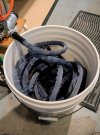
I had the same problem a few years ago with a frozen hose on brew day. So I put it in a snow bank and even though it was pretty cold, it took hours to chill. This was before I had a pump so I had to keep going outside and stirring and checking the temp. Before the next brew day I went and bought one of those flexible hoses. They are light and very flexible and fit nicely into a plastic bucket. I keep it in the basement with my brew equipment and carry it out and hook it up near the end of the boil.

flex hose.jpg
 
I have the opposite problem in the summer. For a lager, I found that I can cool the wort to 80 with the wort chiller. If my refrigerator is set at 48, it will take about 3 hours to go from 80 to the lower 60s where I like to pitch a lager yeast. At 44 overnight, I think that might be a little chilly to pitch, but that will depend on the yeast. I like to ferment 34/70 around 55 until low krausen. After low krausen, I now like to run it about 60 or 61 to get it really clean.
At 55, and with a very heavy pitch, at least with 34/70, it will start quickly. I don't think I would want to ferment it in the 40s. Lager it? Sure. Ferment it, no.
I found a calculator online the estimates future wort temperature based on an original wort temp, an ambient temp, and a length of time.
Josh was telling me about cooling a wort in a snow bank. I got a chuckle out of that since it hasn't snowed here in about 36 years.
I use the coil chiller to get to "around 100F"-ish, and when temps drop below 180, I begin recirculating. I put the coil in the boiling wort about 15m prior to flame out. At the same time, I fire up the glycol chiller. Once I've got the wort to 99 or lower I shut the water off and t/f to the fermenter. I spend a few minutes making connection to the glycol chiller and once ready, start the chiller lines. I set the temp to about 5 degrees under pitch temp for a lager, a few over for an ale and then set about some minor clean up the all in ones. I grab a beer, get the yeast if I did a starter. If I'm pitching a harvested batch, I pull that from the fridge at a few minutes after the start of the boil. Once I'm ready to pitch I drop in the tilt, get a stable reading and if the temp is out of range, adjust the chiller. When the temp is close, to the yeast room temp for the starter yeast, or a bit cooler for the harvested sample, I add in the yeast, set the chiller target and let it rip.
 
I made a counterflow chiller as described in How to Brew, 30 ft coil, works great. If I were to do it again I’d use 3/4” pex instead of a garden hose.
 
Yeah don't work so hard just cover it so no crap blows in really nothing bad in the air at those temps. Also what I would do was fill a bin with a little water set your pot in it and keep adding snow if you have it . Keep it slushy chills pretty quickly
I've built a snow cave off my porch and lagered kegs all winter that way. Got to make the cold work for you
0aa5ef9812ed4f7a03738f0a7d2785ca53a1336e.jpg


This was a few years ago
 
Yeah don't work so hard just cover it so no crap blows in really nothing bad in the air at those temps. Also what I would do was fill a bin with a little water set your pot in it and keep adding snow if you have it . Keep it slushy chills pretty quickly
I've built a snow cave off my porch and lagered kegs all winter that way. Got to make the cold work for you
View attachment 33726

This was a few years ago
That's pretty clever!
 
brewing in cold climates is always easier that's why all the best brewing countries are in the north and wine countries in the south
I personally brew a lot more in the winter especially lagers
 
Interesting! What is the freezing temp of a beer say 5% alcohol?
 
Not sure maybe 20°F
It doesn't get as cold as ambient air temp in the cave so it won't get as low as nighttime temps
I've froze beer before no harm
 
Even fermenting in the garage as far south as I am, the lagers are much easier to do in the winter. Summers are nice for a Saison. It isn't too difficult to keep something in the mid 70s or 80s in the summer when it is 90 something or 100 in the garage.
 
Brewing by the seasons is the way to go keeps you grounded
That's how I started and even with temperature control I still do
I mash indoors but my garage doors are east facing and has an overhang. Nothing gives me as much pleasure is brewing with snow coming down
 
Even fermenting in the garage as far south as I am, the lagers are much easier to do in the winter. Summers are nice for a Saison. It isn't too difficult to keep something in the mid 70s or 80s in the summer when it is 90 something or 100 in the garage.
Get AC in the garage. :)
 

Back
Top