
Guinness clone with a twist

Little update.
I cross measured and checked my sensor correction numbers today. Voilá numbers were of by 4-5 points, so my sensor said 68 C but real was 72-73 C, i don´t know if this has some meaning. This also means that my pitch temp wasn´t 20C but 24-25C.
That’s a bit hot for a mash, and that could be responsible for poor attenuation. The enzymes converting starch to sugar might have been denatured. It’ll still be beer, and maybe not bottle bombs.
 
Little update.
I cross measured and checked my sensor correction numbers today. Voilá numbers were of by 4-5 points, so my sensor said 68 C but real was 72-73 C, i don´t know if this has some meaning. This also means that my pitch temp wasn´t 20C but 24-25C.

Yeah, if you mashed at 72C or 73C, you aren't going to get e very fermentable wort. Recalibrate and brew again!
 
Good to finally find some reasons, easier to hope better outcome next time.

Rex c-100 PID is scrapped, i ordered earlier Inkbird itc106 vh PID, should arrive today. Will change that before next try.
 
Inkbird has arrived to my table. Hopefully i have time next week to install it.
20251114_195320.jpg
 
All kinds of interesting stuff on that table!
 
Saturday was bottling day.

There are couple of things that need to be improved in future, not all can be done for next batch.
Couldn´t use spigot cause there was over inch thick sediment layer at bottom, was kind of surprised of that.
Mashing and pitching temp aka PID controller.
Mishap with hops.
Cooling system.
Fermenter and fermenting cabinet.
 
Saturday was bottling day.

There are couple of things that need to be improved in future, not all can be done for next batch.
Couldn´t use spigot cause there was over inch thick sediment layer at bottom, was kind of surprised of that.
Mashing and pitching temp aka PID controller.
Mishap with hops.
Cooling system.
Fermenter and fermenting cabinet.
Could’ve been worse.
 
That is true.

Now PID is changed. Test run with water today if time
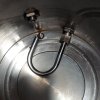
My brewzilla has its temp sensor on the bottom plate, right where the heating coils are. While the pump inlet is also there, helping move wort past the sensor, it still reads 10 F high, very consistently. Once I changed the calibration, temps were spot on when measured in the middle of the mash.
 
My brewzilla has its temp sensor on the bottom plate, right where the heating coils are. While the pump inlet is also there, helping move wort past the sensor, it still reads 10 F high, very consistently. Once I changed the calibration, temps were spot on when measured in the middle of the mash.
I had problems wit the temps in my Anvil with the sensor up from the bottom.
I added a piece of pipe so the pump pulled suction across the sensor.
 

Attachments

  • 20241209_144636.jpg
    20241209_144636.jpg
    173.7 KB · Views: 13
Right now i have temp sensor freely moveable, i can stick it middle of the grain bag. i have plans to do 1 thermowell(copper pipe) to lid and another(stainless steel) to side of kettle.
 
Right now i have temp sensor freely moveable, i can stick it middle of the grain bag. i have plans to do 1 thermowell(copper pipe) to lid and another(stainless steel) to side of kettle.
A true McGuiver, a Wisers clap for you sir!
(if you don't get the reference, just say so and I will share)
 
Saturday was bottling day.

There are couple of things that need to be improved in future, not all can be done for next batch.
Couldn´t use spigot cause there was over inch thick sediment layer at bottom, was kind of surprised of that.
Mashing and pitching temp aka PID controller.
Mishap with hops.
Cooling system.
Fermenter and fermenting cabinet.
That is why people use a bottling bucket and an auto syphon. You are always going to have sediment on the bottom of the fermenter. The plastic fermonsters are shaped so you can place the auto syphon just above the bottom.
If you are using a spigot, it needs to be high enough to be above the sediment.
 
That is why people use a bottling bucket and an auto syphon. You are always going to have sediment on the bottom of the fermenter. The plastic fermonsters are shaped so you can place the auto syphon just above the bottom.
If you are using a spigot, it needs to be high enough to be above the sediment.
Yeah and mine wasn´t, i was using bucket from i usually bottle wines, that point wine is clear and has only little something on the bottom of bucket.

Also i was too lazy and greedy same time, i dumped too much this sediment from mash kettle. Flow through valve was too slow for my taste and i poured it instead and whoops too much... Next time i know better
 
That is why people use a bottling bucket and an auto syphon. You are always going to have sediment on the bottom of the fermenter. The plastic fermonsters are shaped so you can place the auto syphon just above the bottom.
If you are using a spigot, it needs to be high enough to be above the sediment.
Second to that. Also, spigots area notorious source for infections. They're always suspect if they're not taken apart and cleaned pretty much every time they're used. For bottling and auto siphon and bottle-filler shut-off tube are essential, in my opinion. :)
 
I always bottle from my spigot. :(

I tip my fermenter away from the spigot during fermentation to keep gunk away and always Star-San the outlet before bottling. The first few ounces out of the fermenter are for a gravity reading, the rest flows through a piece of tubing that reaches to the bottom of pre-primed bottles. 10 minutes for a case of beer and one short piece of hose to clean, that's it. Science may say I'm fouling up the beer doing it this way but I'm comfortable with my results. I used to go the bottling bucket route and had no complaints with the results doing it that way...just took way longer and had way more to clean.
 

Back
Top